Query Errors
The section illustrates common query errors and how to resolve them on Appsmith.
Query/API response errors
You may see below errors when working with API or Query responses.
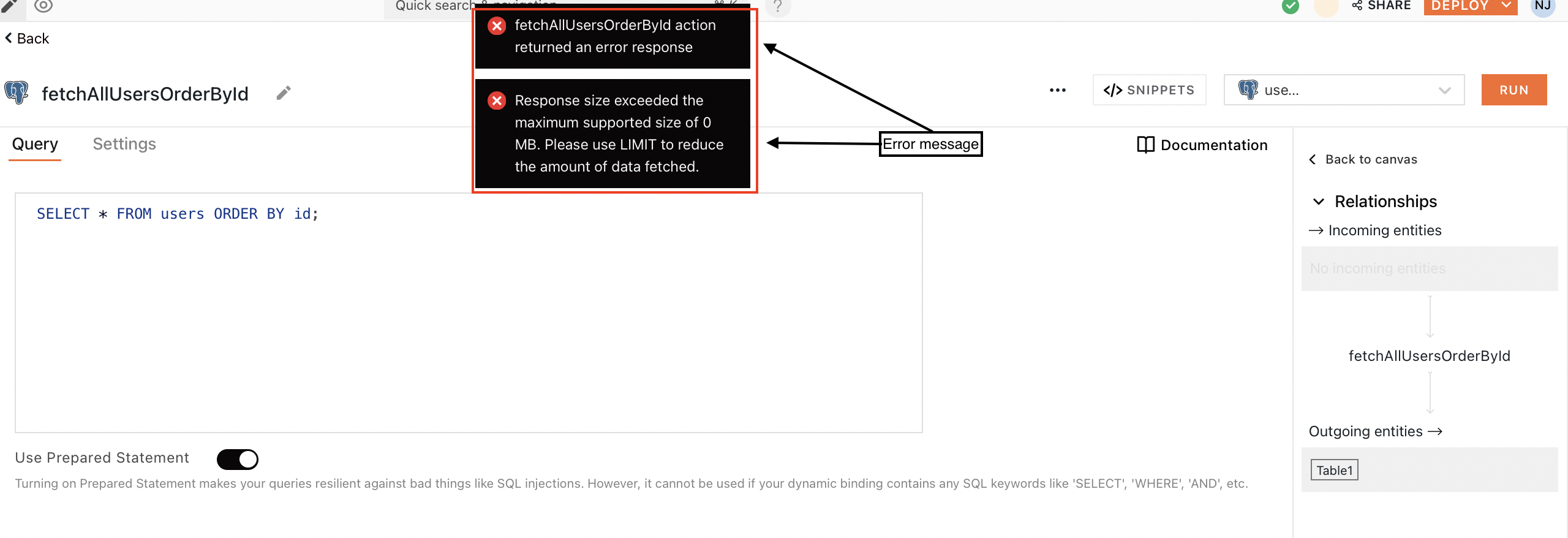
Execution failed with status 5009
You could see the query/API execution fails and generates an error response:
Error message
Cause
The error response could be caused when the API/query response size exceeds the allowed maximum limit of 5 MB or the size setup.

Solution
You could resolve the error response by doing one of the following:
- To limit the data returned as part of query response by using limit in the query or enabling pagination for table.
- To limit the data for an API, you'll have to add a server-side pagination feature to it.
- To update the maximum allowed limit, you can modify the environment variable only for the self-hosted instance of Appsmith. For example, to modify the limit for docker-based installation, navigate to the
docker.envfile and modify theAPPSMITH_PLUGIN_MAX_RESPONSE_SIZE_MBenvironment variable to the desired response size(10 MB).
APPSMITH_PLUGIN_MAX_RESPONSE_SIZE_MB=10
If you can't find what you are looking for and need help debugging an error, please raise your issue on Discord Server or email at support@appsmith.com.
MongoDB name can not be null
You may encounter this error when trying to run queries against a MongoDB datasource.
Error message
The error message might appear in a few different ways. For example:
- As an error response in the console:
- As a notification with the text:
- Or,
Cause
This error may be caused by the database name being omitted from the Connection String URI field.
Solution
Find your Connection String URI in the datasource settings and verify that the database's name is in the string following the host name. For example, if your database name is Movies, it should look something like this:
// Connection String URI

mongodb+srv://mockdb-admin:****@mockdb.kce5o.mongodb.net/movies?w=majority&retrywrites=true&authsource=admin&minpoolsize=0
In the snippet, mockdb.kce5o.mongodb.net/ is the host, movies is the database name, and the items after the ? are optional arguments.

If you can't find what you are looking for and need help debugging an error, please raise your issue on Discord Server or email at support@appsmith.com.
Incorrect syntax / malformed SQL with mustache bindings
Cause
When a mustache binding (for example {{ Select1.selectedOptionValue }}) is placed directly inside an SQL statement, the bound value may be substituted in a format the database does not accept, producing a syntax error. This commonly happens when the value's datatype or quoting does not match what the column or clause expects.
Solution
- Make sure the value passed by the binding is in a format supported by your database (for example, correct quoting for strings, numeric values where numbers are expected).
- For server-side paginated queries, keep the pagination clause well-formed, for example:
SELECT * FROM your_table
ORDER BY some_column
OFFSET (({{Table1.pageNo}} - 1) * {{Table1.pageSize}}) ROWS
FETCH NEXT {{Table1.pageSize}} ROWS ONLY; - If the database still rejects the substituted query, disable Use Prepared Statement in the query settings and re-run. For more information, see Prepared Statements.
GraphQL pagination variable not recognized
Cause
When configuring cursor-based pagination for a GraphQL query, Appsmith may not detect a pagination variable if the parameter it maps to is not declared at the start of the query. As a result, the variable cannot be selected in the Pagination tab.
Solution
- Place the first pagination parameter on the first line of the query definition. After doing this, the pagination parameters become selectable in the Pagination tab.
- Ensure all variables used in pagination are also declared in the query's variables. For more information, see Server-side pagination.
Dynamic bindings in an authenticated API datasource
Cause
Dynamic bindings (such as {{appsmith.store...}}) are not supported in the configuration of an Authenticated API datasource (for example, in a datasource-level header). Values bound there will not evaluate.
Solution
- Add the dynamic binding to the query headers instead of the datasource configuration. Dynamic bindings work in a standard REST API query.
- If you need different values per environment, set up a separate datasource for each environment so that dynamic bindings are not required. See Authenticated API.
File upload fails to parse multipart content
Cause
This error appears when a file-upload API receives data that is not in the format the multipart body expects, for example when the Filepicker data format and the API body type are mismatched.
Solution
- Set the Filepicker widget's Data Format property to Base64. See Data format.
- Set the API Body type to Binary, and pass the file data using
{{ FilePickerName.files[0].data }}. - For a complete walkthrough, see Upload Files using API.
Binary REST API response is corrupted or truncated
Cause
When an API returns raw binary data (for example audio or other non-text files), Appsmith's REST API plugin parses the response as text. The binary content is corrupted by UTF-8 interpretation, so it cannot be reliably reconstructed, and large responses may also be truncated.
Solution
- If the API offers an endpoint that returns the data as Base64, use that endpoint instead, since Base64 responses are supported by the REST API plugin. You can then decode it client-side.
- If the response only exceeds the size limit (rather than being binary), see Execution failed with status 5009 above.